
Quick answer: Tracks spread a machine’s weight over a much larger contact area than tyres and keep drive where wheels would spin, so a tracked lift suits uneven or unlevel ground, dirt and light mud. Non-marking rubber tracks also work on hard ground and finished floors. Tracks do not make a machine suitable for every surface, do not remove slope limits, and do not guarantee zero marking. They change the odds; they do not remove the need to assess the ground.
Describe the surface and we will tell you honestly whether tracks are worth the difference.
Help me chooseWhat tracks can change
- Ground pressure: the same weight spread over a much larger footprint, so dirt and uneven ground are less likely to rut
- Traction: tracks keep drive on dirt, light mud and loose surfaces where tyres would spin
- Hard floors: non-marking rubber tracks also work on slab and finished floors when the machine is driven carefully
- Access: many tracked lifts are deliberately narrow for gate and doorway access, then stabilise on outriggers at the work position
What tracks do not solve
- They do not remove the manufacturer’s slope and levelness limits for elevation
- They do not make saturated, unstable or undermined ground safe to work from
- They do not eliminate surface marking; a heavy machine pivoting on a wet surface can still leave marks
- They do not replace a ground assessment where floor loading or buried services are in question
Ground condition questions to ask
Before assuming tracks are the answer, establish: what is under the surface (topsoil, fill, sand, a slab, an irrigation system), how wet it has been, whether the route crosses driveways or drains, and whether the ground will change during the hire. A surface that carries the machine on delivery day can behave very differently after two days of rain. Our guide to ground conditions and equipment selection goes deeper on this.
Narrow access and transport width
Tracked lifts are often chosen as much for their access as their ground manners: stowed widths that pass through gates and single doorways, then outriggers that spread at the work position. Check the outrigger footprint as well as the stowed width; the machine needs room to set up where the work is, not just to pass through the gate. Measure using the width and site access guide.
Slopes, levelling and manufacturer limits
Outrigger-equipped tracked lifts can set up level on unlevel ground that would rule out a wheeled scissor, within the levelling range the manufacturer specifies. That range is a hard limit, not a starting point for negotiation. On sloping sites, tell us the approximate gradient and we will check it against the specific machine before quoting.
Surface protection and site planning
Where a surface must be handed back unmarked, tracks are one part of the plan. Track mats or ply under the travel path, gentle steering inputs, avoiding tight pivots, and planning the route to minimise passes all matter. If a surface must be handed back perfect, say so in the quote request so the plan reflects it.
Tracked equipment compared with rough-terrain wheels
| Tracked lift | Rough terrain (wheeled) scissor | |
|---|---|---|
| Ground pressure | Low, spread across the track area | Higher, concentrated at four tyre patches |
| Uneven ground, dirt and light mud | Often workable, subject to assessment | Risk of rutting and bogging |
| Hard floors and slab | Non-marking tracks, driven carefully | Usually rough terrain tyres, can mark |
| Rough compacted ground | Capable but slower travel | In its element |
| Access width | Often narrow when stowed | Wide |
| Setup | Outrigger deployment at each position | Drive in and elevate, within limits |
| Repositioning frequency | Slower between work points | Fast between work points |
If the ground is rough but firm and the access is generous, the wheeled RT scissor is usually the more productive machine. Tracks earn their keep when the ground is uneven or unlevel, dirt or light mud, or the access is tight.
Recommended equipment
Scissor Lifts Why it may suit: 19ft tracked hybrid (bi-energy) self-levelling scissor lift, 7.9m working height, 250kg, bi-levelling crawler undercarriage for slopes and rough ground. Runs plugged in to 15… Worth checking: Tracked repositioning is slower than wheeled. Electric running is tethered and needs a 15 amp supply on a lead, because there is no on-board battery: if a 15 amp outlet is not within reach of the work area the machine runs on its separate Kubota diesel engine instead, so confirm the power before an indoor or enclosed job. Confirm the surface rating before tracking over finished ground. Matched on verified fields: Working height, Platform height, Width, Power, Terrain. Site access, ground conditions and dates still need checking against your job. Scissor Lifts Why it may suit: 19ft tracked hybrid (bi-energy) scissor lift with 7.9 m working height and 250 kg on a full 1.50 by 1.20 m basket. Levels on… Worth checking: Tracked repositioning is slower than wheeled. Electric running is tethered and needs a 15 amp supply on a lead, because there is no on-board battery: if a 15 amp outlet is not within reach of the work area the machine runs on the Kubota diesel instead, so confirm the power before an indoor or enclosed job. Confirm the surface rating before tracking over finished ground. Matched on verified fields: Working height, Platform height, Width, Power, Terrain. Site access, ground conditions and dates still need checking against your job. Suitability is subject to site access, ground conditions and availability. We confirm the machine against your job before hire. Diesel Rough Terrain Scissor Lifts Why it may suit: 32ft diesel rough-terrain scissor lift, 11.75m working height, 454kg and a 1.52m extension deck: 4WD, drivable at full height. Worth checking: Diesel engine — outdoor use only. Outdoor platform occupancy limited to two people in CE/AUS markets. 1.75m wide, 3.76m long stowed — plan site access. Matched on verified fields: Working height, Platform height, Width, Power, Terrain. Site access, ground conditions and dates still need checking against your job. Diesel Rough Terrain Scissor Lifts Why it may suit: 32ft diesel rough-terrain self-levelling scissor lift, 12.06m working height, 450kg: 4WD, 40% gradeability and four outriggers. Worth checking: Diesel engine — outdoor use only. Outriggers must be set before elevating on uneven ground. Matched on verified fields: Working height, Platform height, Power, Terrain. Site access, ground conditions and dates still need checking against your job. Suitability is subject to site access, ground conditions and availability. We confirm the machine against your job before hire.Tracked options in the fleet

Athena 850BL Tracked Scissor Lift
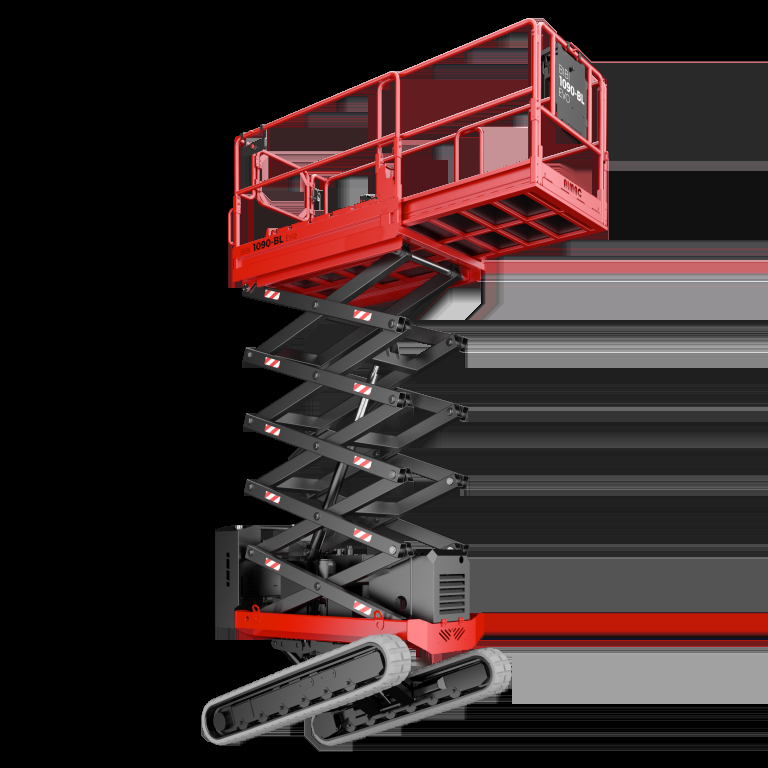
Athena 870 BL EVO Tracked Scissor Lift
Wheeled rough terrain alternatives
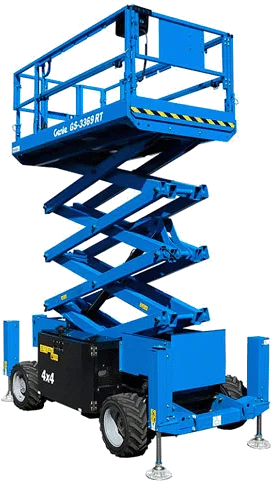
Genie GS-3369 RT Rough Terrain Scissor Lift
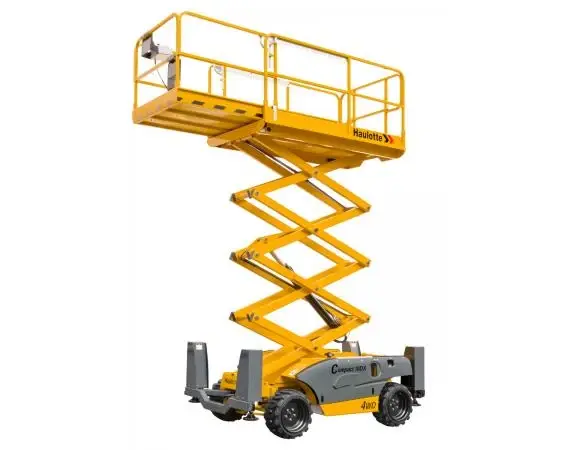
Haulotte Compact 12 DX Rough Terrain Scissor Lift
Information needed before quoting
- The surface, and what is beneath it if known
- Recent weather and drainage on the site
- Gate or doorway widths on the route
- Approximate slope at the work positions
- Whether the surface must be returned unmarked
- Working height needed and the suburb
FAQs
Will a tracked lift damage my driveway?
Rubber tracks driven straight and gently across a sound driveway rarely cause problems, but tight pivots on hot asphalt or brittle surfaces can mark. Mention the surface and we will plan the route and protection accordingly.
Can a tracked lift work on hard ground and indoors?
Yes. Non-marking rubber tracks work on slab and finished floors as well as dirt and uneven ground. Check floor loading and access width before taking it inside.
Are tracked lifts slower to use?
Generally yes: travel is slower and each work position needs outrigger setup. Fewer, better-planned positions offset most of the difference.
Can a tracked lift work on any slope?
No. The levelling system has a specified range, and elevation outside it is not permitted. Tell us the gradient and we will check the machine’s limits.