
Quick answer: before you request a quote, check seven things: the height and reach of the work, the narrowest and lowest points on the route, the ground, overhead hazards, where the delivery truck can stop and unload, power for charging, and the dates. Ten minutes on site with a tape measure and a phone camera answers almost every question we will ask. For the measuring method itself, see site measurements before hiring access equipment.
Checklist done? Send it straight through with your quote request.
Get a Hire QuoteBefore choosing equipment
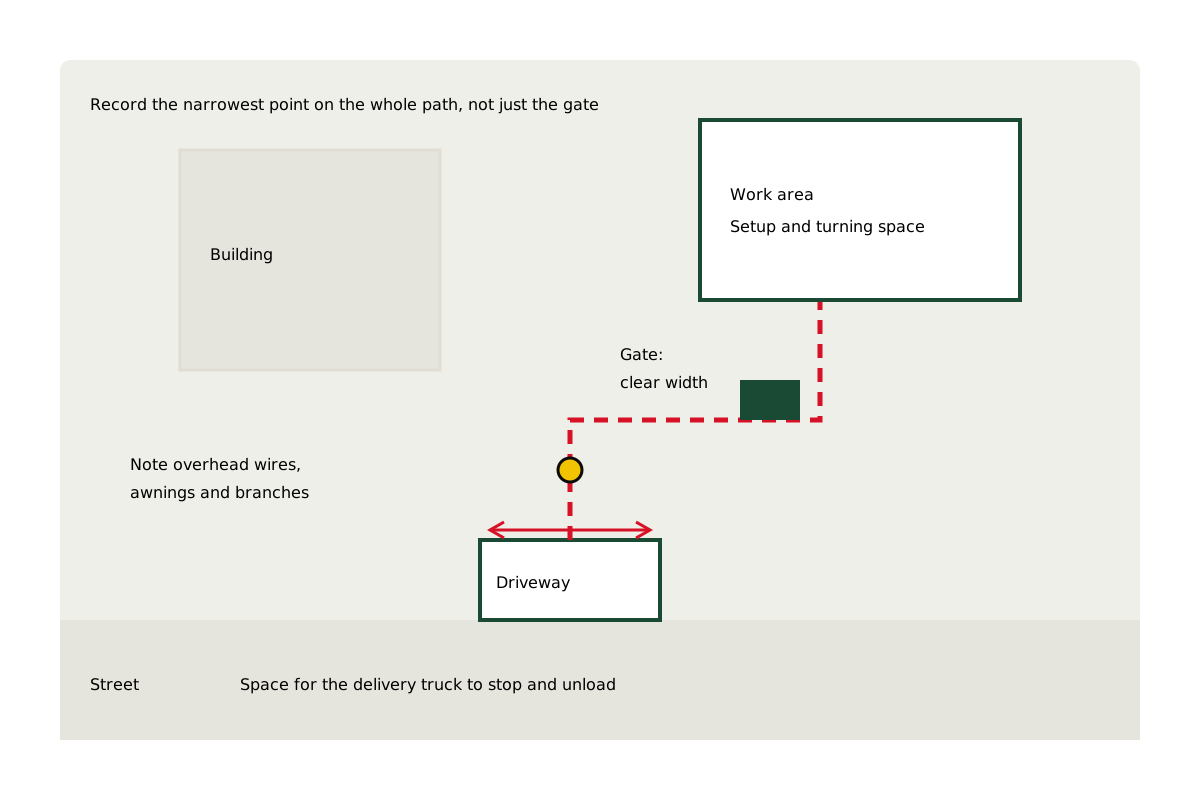
Walk the machine’s route from the street to the work area and look at it the way a machine would: every opening, every step, every surface, everything overhead. Take photos as you go. The checklist below follows that walk.
Height and outreach
- Height of the work itself, measured to the fitting or surface, not the roof
- Whether the machine can sit directly below the work point
- If not, the horizontal distance from where it can sit to where the work is (that points to a boom lift)
- Read working height vs platform height if the figures confuse
Width, length and turning space
- Clear width of every door, gate and aisle on the route, at the tightest point
- Clear height under every opening, awning and service
- Turning space at corners on the route
- Space at the work area for the machine, plus outriggers if fitted
Ground and floor conditions
- What the machine stands on at the work area: slab, pavers, compacted fill, grass
- What the route crosses, including anything soft or recently disturbed
- Suspended floors, mezzanines or old slabs that may need a loading check by the building owner or an engineer
- Slopes, with an approximate gradient
- Drainage: what happens to this ground after rain
On uneven or sloping ground, a tracked self-levelling scissor lift may suit; on a flat slab indoors, an electric scissor lift usually does. Either way the ground still has to support the machine.
Overhead and surrounding hazards
- Power lines near the work or the route
- Trees, awnings, ducts, cranes and other plant overhead
- Traffic, pedestrians and other trades in the work zone
Truck access versus machine access
Two different vehicles have to get in. The truck has to reach the unloading point; the machine then has to travel from there to the work. Check both.
- Truck: where it can stop safely and legally, with room behind or beside it to unload; overhead clearance at that point (trees, wires, awnings), because the deck or ramps need space; whether a council permit or traffic control is needed on the street.
- Unloading point: flat, firm and clear, so the machine is not driven off onto a slope or soft verge.
- Machine route: from the unloading point to the work area, with the width, height, ground and turning checks above.
See equipment delivery, site access and collection for what the driver needs on the day.
Indoor power, ventilation and floor finish
- A standard outlet near the machine’s overnight parking spot, for electric machines
- Ventilation, if any engine-powered plant is being considered indoors
- Floor finish: tell us if the floor is coated, polished or otherwise sensitive
Dates, site contacts and inductions
- Start date, end date, and slack for weather or sequencing
- A site contact name and mobile for delivery day
- Induction or white card requirements for the driver, if any
What to send with your enquiry
- The work height, and the outreach if the machine cannot sit underneath
- The narrowest opening and the lowest clearance on the route
- The ground at the work area and along the route
- Where the truck can stop and unload
- The suburb, dates and site contact
- Photos: the work from far enough back to show its height, the tightest opening with a tape in shot, the ground, the truck stopping area, and anything overhead
We check them against the machine specifications before anything is booked and flag anything that needs a second look. Not sure which machine type yet? Try the machine selector.
FAQs
Do I really need all of this for a simple hire?
For a straightforward job, five answers usually cover it: height, access width, surface, dates and suburb. The full checklist earns its keep on sites with tight access or questionable ground.
Can Equip Hire assess the site instead?
Where the access is genuinely borderline, talk to us about the options. Photos and measurements resolve most questions without a visit.
Is this checklist a safety assessment?
No. It is a hire planning tool. Site safety assessments, SWMS and operator competency are the responsibility of the people controlling the work.