
Quick answer
Take six measurements before you hire: the height of the actual task, the narrowest opening anywhere on the route in, the overhead clearance the machine passes under, the turning space at the work position, the ground surface and its fall, and the floor loading if the machine works on anything other than a ground slab. Measure the whole route, not the room the work is in. Send a photo of the route and the standing position with the numbers, and we will confirm the machine before it is loaded.
When a delivery fails, it is almost never because the machine was the wrong height. It is because a gate was 0.75 metres, a corridor turned at the wrong angle, a threshold had a step, or the standing position sat on a soft patch nobody looked at. All of those are five minute checks.
This guide lists what to measure, where to measure it and why it matters. It is written for whoever is on site and can walk the route with a tape.
1. Task heightto the fitting, not the roof
2. Narrowest openinganywhere on the route in
3. Overhead clearanceagainst stowed height
4. Turning spaceat the work position
5. Ground and fallsurface, slope, soft patches
6. Floor loadingmezzanine, slab, basement
Then one photo of the route in and one of where the machine has to stand. That answers most of the rest.
What is the difference between working height and platform height?
Platform height is where the platform floor stops. Working height is the platform height plus about two metres for a person standing on it and reaching. The number in a machine name, the 19ft or 26ft, is the platform height in feet.
So a 19ft machine has a 5.8 metre platform height and a 7.8 metre working height. Order against the working height and against the task, and there is a full explanation in working height versus platform height.
How do I measure the height I actually need?
Measure to the task, not to the ceiling. The underside of the beam, the light fitting, the top of the racking, the gutter line. A tape on an extension pole or a laser measure both work; so does counting a known course height on brickwork.
Then choose a machine whose working height covers it with margin. If the task is at 7.5 metres, a 7.8 metre machine is technically enough and practically tight. Step up. Reaching out over the guardrail to save a size is the single most common way people get hurt on these machines. The working height calculator does the arithmetic.
What width do I measure, and where?
The narrowest point of the entire route from where the truck can unload to where the machine has to work. Gates, personnel doors, roller doors, corridors, lift car openings, the space between a bollard and a wall, and any point where the route turns.
Measure the clear opening, not the frame. A door leaf that only opens to 80 degrees, a closer arm, a handle, a hinge or a floor stop all reduce the usable width. Our narrowest machines are 0.79 and 0.81 metres, against a standard single door opening of about 0.82 metres, so there is nothing to spare.
How much clearance should I allow beyond the machine width?
For a straight run through an opening, a few centimetres is workable with a careful operator. For a route with turns, allow enough room to turn: that is the outside turning radius, not the machine width.
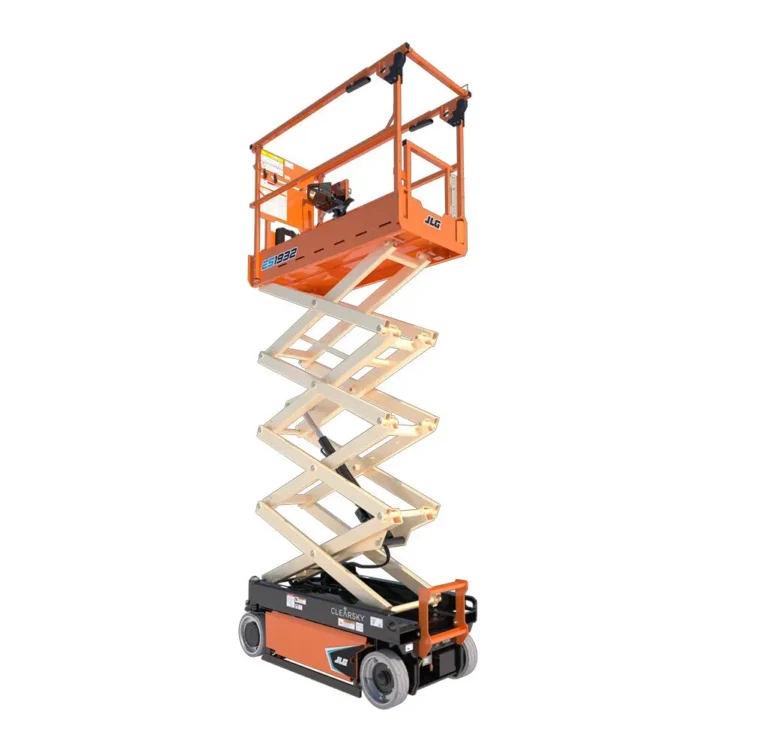
The JLG ES1932 turns with a zero inside radius and 1.7 metres outside. The Zoomlion ZS0808AC is 0.1 metres inside and 2.1 metres outside. A corridor wide enough for the machine but too tight for its outside radius stops the job just as effectively as a narrow door.
What overhead clearance does the machine need on the way in?
Check the stowed height against every opening it passes under: doorways, roller doors that do not fully retract, awnings, mezzanine soffits, ducting, pipework and car park height bars.
Folding the guardrails is usually what makes it fit. The ES1932 is 1.99 metres stowed and 1.63 metres with the rails folded. The ZS0808AC is 2.4 metres and 1.9 metres. A car park with a 2.1 metre height bar will not take the ZS0808AC upright but will take it folded.
How much turning room does it need at the work position?
Enough to get the platform where it needs to be and get out again. Think about the position of the work relative to a wall or a racking upright: a machine that can reach the fitting but cannot be squared up to it is not much use.
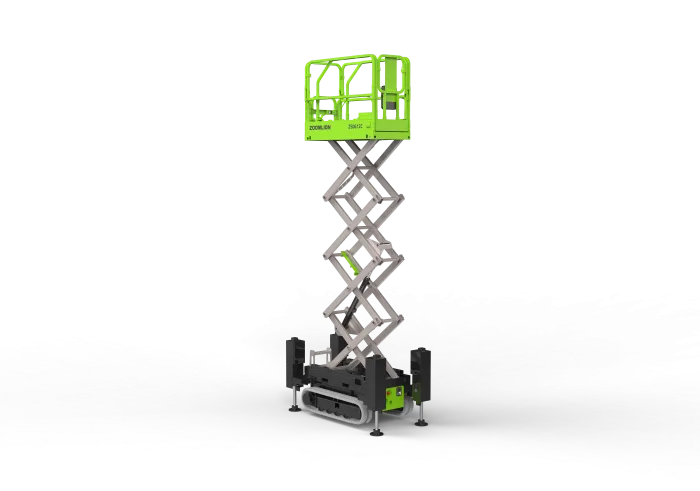
Where the work runs along a wall or a racking bay, check whether the machine can drive along at height. Our wheeled electric machines can, at reduced speed. Our Zoomlion ZS0612C tracked machine cannot, and has to be lowered to reposition, which changes how much turning room you need at every position.
What do I need to know about floor loading?
The machine weight and the load limit of the floor. Our machines run from 1,550 kilograms for a 19ft electric scissor up to 5,400 kilograms for the knuckle boom, and that load arrives through four small contact patches rather than being spread out.
On a purpose built ground floor slab this is rarely a question. On a mezzanine, a suspended floor, a basement car park roof, an older slab, a driveway over services or a septic system, it is a real one and it needs the building documentation or the engineer. Send us the stated limit with the machine you are considering; there is more in machine weight and floor loading.
How do I measure a slope?
A spirit level on a one metre straight edge, or a level app on a phone laid on a board. Measure across the standing position in both directions, not just down the fall line.
Then check it against the right figure. Gradeability is the slope a machine can drive up when stowed; maximum working slope is the ground it can lift on, and it is always much tighter. The Zoomlion ZS0808AC has a 25 per cent gradeability but a maximum working slope of 1.5 and 3 degrees. Our tracked ZS0612C works to 12 degrees laterally and 7 degrees vertically once levelled on its legs.
What about thresholds, kerbs, ramps and steps?
Measure the rise. A compact electric scissor has very little ground clearance and no ability to climb a step: the LGMG SC0610EL-2 tracked machine records 0.115 metres of ground clearance and the AR11J boom 0.19 metres.
A door threshold, a kerb at the end of a driveway, a lip at a roller door or a step into a loading bay all need either a ramp or a different route. A temporary ramp needs to be rated for the machine weight; a plank is not a ramp.
What does the delivery truck need?
A route it can drive, somewhere to stop legally, overhead clearance to tilt the tray, and a firm level area to unload onto. Overhead power lines, low branches, awnings and car park height bars are the ones that stop a truck.
The unloading area is separate from the work area. The machine can walk to the work; the truck cannot. There is more in the delivery and site access guide.
How accurate do the measurements need to be?
To the centimetre where a machine is close to the limit, and honest where it is not. If a gate measures 0.83 metres and the machine is 0.81 metres, that is a real 20 millimetres and it needs to be right.
Round down, not up. Measure the tightest point rather than a typical one. And do not send us a nominal figure from a plan: a 900 millimetre door on a drawing is often 820 millimetres of clear opening once the frame, the stop and the leaf angle are accounted for. A nominal clearance is not guaranteed access, and we will always ask for the measured one.
What should I send with my enquiry?
The six numbers above, a photo looking along the route in, and a photo of where the machine has to stand. That is enough for us to confirm the machine, the delivery method and the unloading point in one reply.
If a measurement is awkward to take, tell us that instead of guessing. We would much rather have “the gate is somewhere around 900 and I cannot get to it today” than a confident number that turns out to be wrong at the kerb.
Next step
Run the numbers through the site access checker and the working height calculator, then send them with your enquiry. If you are choosing between machine classes first, start at electric scissor lifts or boom lifts.
Machines sized to your measurements
Every machine page lists the width, stowed height, weight and working height from its specification sheet.
Combos
19ft Electric Scissor Lift + Eco Plant 2 Trailer Combo: JLG ES1932
Why it may suit: The JLG ES1932 electric scissor lift with the Eco Plant 2 plant trailer to tow it, quoted as one booking for approved customer pickup.
Combos
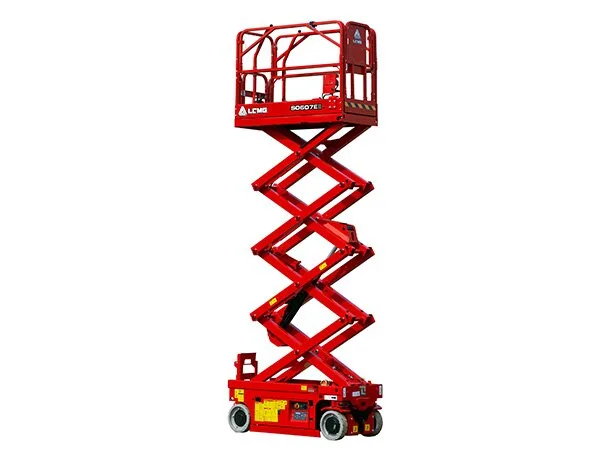
19ft Electric Scissor Lift + Eco Plant 2 Trailer Combo: LGMG S0607E II
Why it may suit: A 19ft electric scissor lift and the Eco Plant 2 plant trailer to tow it, quoted as one booking for approved customer pickup.
Combos
19ft Tracked Scissor Lift + DP35 Plant Trailer Combo: Zoomlion ZS0612C
Why it may suit: A 19ft tracked scissor lift for lawns, pavers and soft ground, with the 3.5 tonne DP35 plant trailer to move it, quoted as one…
Suitability is subject to site access, ground conditions and availability. We confirm the machine against your job before hire.
We deliver from Berkshire Park across Sydney, Western Sydney, the Central Coast and the rest of NSW.